High-pressure pumps for professional and industrial systems
High-pressure pumps convert mechanical power from an electric motor, combustion engine or hydraulic drive into a controlled flow of pressurised water. They are used wherever standard water-supply pressure is insufficient for effective cleaning, spraying, misting, surface preparation or industrial processing.
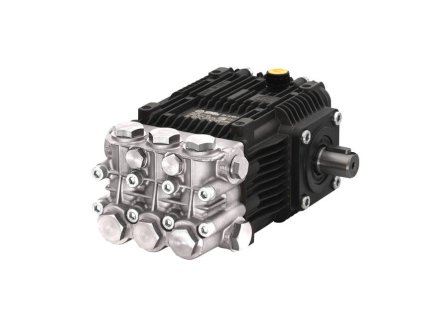
This category focuses primarily on professional triplex plunger pumps for pressure washers, car washes and industrial installations. The range includes compact pumps for single-lance cleaning systems, pumps for continuous-duty self-service car washes, high-flow models for automatic washing equipment and specialist pumps for applications requiring pressures up to 500 bar.
A suitable pump cannot be selected from maximum pressure alone. Flow rate, normal working pressure, rotational speed, motor power, inlet-water conditions, temperature, chemical exposure and mechanical compatibility must be evaluated together.
How to choose a high-pressure pump
| Selection parameter |
What it determines |
What must be checked |
| Flow rate |
The amount of water delivered to the nozzle or washing circuit. |
Nozzle capacity, number of simultaneous outlets, hose losses and available water supply. |
| Working pressure |
The cleaning impact and the resistance the pump must overcome. |
Normal operating pressure, maximum pump rating and pressure loss between the pump and nozzle. |
| Pump speed |
The delivered flow and compatibility with the motor or drive system. |
Rated rpm, pulley ratio, gearbox, coupling and maximum permitted speed. |
| Motor power |
Whether the system can produce the required flow and pressure continuously. |
Absorbed pump power, motor efficiency, electrical supply and operating reserve. |
| Water temperature |
The required seals, manifold design and inlet conditions. |
Continuous inlet-temperature rating, bypass heating and hot-water compatibility. |
| Duty cycle |
The required pump construction and operating reserve. |
Daily operating hours, continuous or intermittent use and time spent in bypass. |
| Mechanical dimensions |
Whether the pump can be installed in the existing machine. |
Shaft diameter, keyway, rotation, foot spacing, shaft height and connection positions. |
High-pressure pump brands
UMYTEC supplies pumps from established manufacturers covering different performance ranges, applications and installation requirements. The brand pages provide detailed information about individual pump families, model designations and available products.
| Brand |
Typical product focus |
Explore the range |
| HAWK |
Compact, car-wash, hot-water, high-flow and industrial high-pressure pumps. |
View HAWK pumps → |
| Interpump |
Professional washing, car-wash, high-temperature, high-flow and water-jetting pumps. |
View Interpump pumps → |
| CAT Pumps |
Continuous-duty car-wash, pressure-washer and industrial plunger pumps. |
View CAT Pumps → |
| UDOR |
Compact washing pumps, chemically resistant car-wash pumps and high-flow industrial models. |
View UDOR pumps → |
Do not select a pump only by brand or maximum pressure. Two pumps rated for the same pressure may have different flow, rpm, power requirements, temperature limits, shaft dimensions and permitted duty cycles.
Read the complete high-pressure pump selection guide Pump operation, pressure classes, applications, motor sizing, installation and replacement selection
What is a high-pressure plunger pump?
A high-pressure plunger pump is a positive-displacement pump in which a crankshaft moves ceramic plungers backwards and forwards inside the hydraulic section. During the inlet stroke, water enters the pump through an inlet valve. During the pressure stroke, the water is displaced through a discharge valve into the high-pressure circuit.
Most professional washing pumps use three plungers and are therefore described as triplex plunger pumps. The three pumping chambers deliver water in overlapping pulses, producing a more stable flow than a single-piston design.
The pump generates flow. Pressure develops when that flow encounters resistance from the nozzle, hose, regulating valve and connected equipment. Installing a smaller nozzle increases pressure, but the nozzle must never be reduced below the safe operating limit of the pump, motor and complete system.
Flow rate versus working pressure
Flow rate and pressure perform different functions. Flow determines how much water reaches the cleaned surface, while pressure determines the force with which the water exits the nozzle.
A higher-flow pump can rinse contamination and transport loosened dirt more effectively. A higher-pressure pump produces greater impact and is more suitable for removing strongly bonded deposits, coatings or corrosion. The best operating point depends on the application rather than on the highest available number.
| System requirement |
Typical priority |
Examples |
| Compact cleaning system |
Moderate flow, compact dimensions and lower motor power |
Portable pressure washers, detailing and small misting systems |
| Standard professional washing |
Balanced flow and pressure with reliable continuous operation |
Car washes, workshops and machinery cleaning |
| High-flow washing |
Greater water volume and sufficient supply capacity |
Automatic gantry washes, truck washing and municipal equipment |
| Industrial water jetting |
High working pressure and complete system safety |
Paint removal, surface preparation and wet sandblasting |
Selecting a pump by pressure class
The maximum pressure stated on a pump is a mechanical limit, not necessarily the recommended continuous operating pressure. A suitable operating reserve helps protect the pump, valves, seals and drive system.
| Pressure class |
Typical applications |
Main selection considerations |
| Up to 150 bar |
Misting, vehicle washing, rinsing and high-flow cleaning |
Flow rate, nozzle capacity and water-supply volume |
| Up to 200 bar |
Professional pressure washers, self-service car washes and industrial cleaning |
Continuous duty, motor power and chemical exposure |
| 200–350 bar |
Heavy machinery, construction cleaning and surface treatment |
System pressure rating, hose losses and motor reserve |
| 350–500 bar |
Water jetting, coating removal, wet sandblasting and industrial maintenance |
Operator safety, guarding and compatibility of every pressure-bearing component |
High-pressure pumps by application
Pressure washers
Professional pressure-washer pumps normally require a balanced combination of flow and pressure, compact dimensions and compatibility with an electric motor or combustion engine. The selected pump must match the nozzle, unloader valve and available motor power.
Self-service car washes
A self-service car-wash pump must tolerate frequent starts, long daily operating periods, changing programmes and possible exposure to detergents or reclaimed water. Serviceability, water treatment and the design of the bypass circuit are as important as the nominal pressure.
Automatic car and truck washes
Automatic washing systems often require higher flow because several nozzles or washing arches operate simultaneously. Pump selection must therefore consider the complete nozzle flow, supply-water capacity and number of active circuits.
Industrial cleaning
Industrial high-pressure pumps are used for machinery cleaning, food-production sanitation, degreasing, surface preparation, tank washing and process applications. Material and seal compatibility must be checked whenever the pumped liquid contains detergents, solvents, salts or process chemicals.
Misting and cooling
Misting systems require stable pressure, accurately calculated nozzle flow and fine water filtration. A pump that is too large may spend excessive time in bypass, while an undersized pump cannot maintain pressure when all nozzles are open.
Municipal and sewer-cleaning equipment
Mobile municipal systems may require high flow, engine or hydraulic drive and reliable operation with a large water tank. The pump must be selected together with the gearbox, hydraulic motor, inlet line and vehicle power source.
Water jetting and surface preparation
Applications above approximately 300 bar require a complete system designed for high-pressure operation. The pump, valves, hoses, fittings, gauges, guns, lances and nozzles must all have a suitable working-pressure and safety rating.
Motor power and pump speed
The hydraulic power required by a pump increases with both flow and pressure. A practical theoretical estimate is:
Hydraulic power in kW ≈ flow in l/min × pressure in bar ÷ 600
The motor must provide more power than this theoretical value because the pump, transmission and motor are not 100% efficient. A suitable design reserve is also required for starting, temperature changes and long-term operation.
Pump flow changes approximately in proportion to rotational speed. Reducing the rpm normally reduces the flow. Increasing the rpm above the manufacturer's limit can cause cavitation, excessive wear, seal damage and crankcase failure.
Important: never assume that a pump rated at one operating speed will provide the same flow at another speed. Calculate the expected flow and confirm that the new operating point remains inside the manufacturer's technical limits.
Direct drive, coupling or belt drive
| Drive type |
Advantages |
Important checks |
| Direct drive |
Compact installation with fewer transmission components |
Motor speed, hollow-shaft size, flange and engine compatibility |
| Flexible coupling |
Simple alignment and efficient power transfer at matching speeds |
Shaft diameter, coupling size, bell housing and alignment |
| Belt drive |
Allows the pump speed to differ from the motor speed |
Pulley ratio, belt tension, shaft load, guarding and rotation |
| Gearbox or hydraulic drive |
Suitable for vehicles, engines and mobile industrial systems |
Input speed, reduction ratio, torque, lubrication and mounting |
Pump materials and operating conditions
Standard high-pressure water pumps normally use a brass manifold, ceramic plungers and elastomeric water seals. More demanding applications may require nickel-plated brass, stainless steel or special seal materials.
| Construction |
Typical use |
Selection note |
| Brass manifold |
Clean water, pressure washers and standard car-wash systems |
Confirm detergent concentration and recycled-water quality |
| Nickel-plated manifold |
Car washes, hot-water systems and more aggressive environments |
The plating improves resistance but does not guarantee compatibility with every chemical |
| Stainless-steel manifold |
Food processing, demineralised water, salt water and chemical systems |
All wetted components and elastomers must match the liquid |
| High-temperature version |
Hot-water washing and hygienic cleaning |
Check continuous temperature rather than only the short-term maximum |
Replacing an existing high-pressure pump
A replacement pump should reproduce the required operating performance without overloading the existing motor or creating installation problems. Matching only the flow and pressure is not sufficient.
- Compare the actual flow at the installed rpm.
- Check the normal and maximum working pressure.
- Verify absorbed power against the existing motor.
- Compare shaft diameter, keyway and direction of rotation.
- Measure the mounting holes, shaft height and overall dimensions.
- Check inlet and outlet thread sizes and positions.
- Confirm water-temperature and chemical compatibility.
- Verify that the existing unloader valve and safety components match the new pump.
Changing to another brand may require a new coupling, bell housing, pulley, mounting plate, hose arrangement or pressure-control valve. These changes should be identified before the original pump is removed.
Components required around the pump
A professional high-pressure pump is only one part of the complete system. Correctly matched accessories improve safety, pressure stability and pump life.
- Unloader and regulating valves control working pressure and divert flow when the outlet closes.
- Safety or relief valves protect the system if the regulating valve fails or the outlet becomes blocked.
- Pressure gauges allow the real working pressure to be monitored.
- Inlet filters protect valves and seals from solid contamination.
- Pulsation dampers or accumulators reduce pressure fluctuations in suitable installations.
- High-pressure hoses, fittings, guns and lances must match the pressure, flow and temperature.
- Seal and valve kits support planned maintenance and rapid repairs.
The maximum pressure of every downstream component must be equal to or greater than the maximum possible system pressure.
High-pressure pump maintenance
Maintenance intervals depend on the pump, water quality, temperature, speed and operating hours. Regular inspection can prevent small seal or valve problems from developing into crankcase or plunger damage.
- Check the crankcase oil level and condition.
- Inspect the pump for water and oil leakage.
- Clean or replace the inlet filter regularly.
- Check for pulsation, unusual noise and pressure instability.
- Avoid dry running and insufficient inlet-water supply.
- Do not leave the pump operating in bypass for excessive periods.
- Use the correct seal and valve kits for the complete pump model.
- Protect the pump from freezing when the equipment is not in use.
Pressure loss, pulsation or reduced flow can be caused by worn valves, damaged seals, an incorrect nozzle, air entering the inlet line, insufficient water supply or an incorrectly adjusted unloader valve.
Which high-pressure pump should you choose?
Start with the required operating point: flow, normal working pressure and pump speed. Then verify motor power, water temperature, duty cycle, materials and mechanical compatibility.
For standard professional cleaning and self-service car washes, a balanced medium-flow pump operating within the 150–200 bar class is often appropriate. Automatic washing and municipal equipment may require substantially more flow, while surface preparation and water jetting require a higher pressure class and a fully rated system.
Use the dedicated HAWK, Interpump, CAT Pumps and UDOR pages to compare the available models within each manufacturer’s range.
Frequently asked questions about high-pressure pumps
What is the difference between a high-pressure pump and a pressure washer?
The pump is the component that generates water flow. A complete pressure washer also includes a motor or engine, regulating valve, frame, hoses, gun, lance, nozzle and safety components.
What is a triplex plunger pump?
It is a positive-displacement pump with three reciprocating plungers. Triplex construction provides relatively smooth flow and is widely used in professional high-pressure cleaning systems.
Is flow or pressure more important?
Both are important. Pressure provides cleaning impact, while flow rinses and transports loosened contamination. The correct balance depends on the application.
How much motor power does a high-pressure pump require?
Required power depends on flow and pressure. The theoretical hydraulic power is approximately flow in l/min multiplied by pressure in bar and divided by 600. Motor and pump efficiency plus an operating reserve must then be considered.
Can a pump operate at a lower rpm?
Often yes, provided the speed remains inside the permitted range. Flow decreases approximately in proportion to rpm, while the maximum pressure remains limited by the pump construction and available motor power.
Can a high-pressure pump use hot water?
Only when the pump is rated for the required continuous inlet temperature. Hot-water versions use suitable seals and hydraulic components. The complete inlet and bypass circuit must also be temperature compatible.
Can one pump replace a model from another brand?
Yes, in some installations. Flow, pressure, rpm, power, shaft dimensions, rotation, mounting points, connections, temperature rating and materials must all be compared.
What causes a high-pressure pump to pulsate?
Common causes include worn or contaminated valves, air entering the inlet line, insufficient water supply, an incorrect nozzle, damaged seals or an unstable regulating valve.
Which information is needed to select a replacement pump?
Provide the complete existing pump model, required flow and pressure, rpm, motor power, water temperature, application and photographs or measurements of the shaft, mounting points and connections.
Need help selecting a high-pressure pump?
Send us the required flow, working pressure, rpm, motor data and complete designation of your existing pump. We can help compare suitable pumps and compatible system components.
Contact UMYTEC →